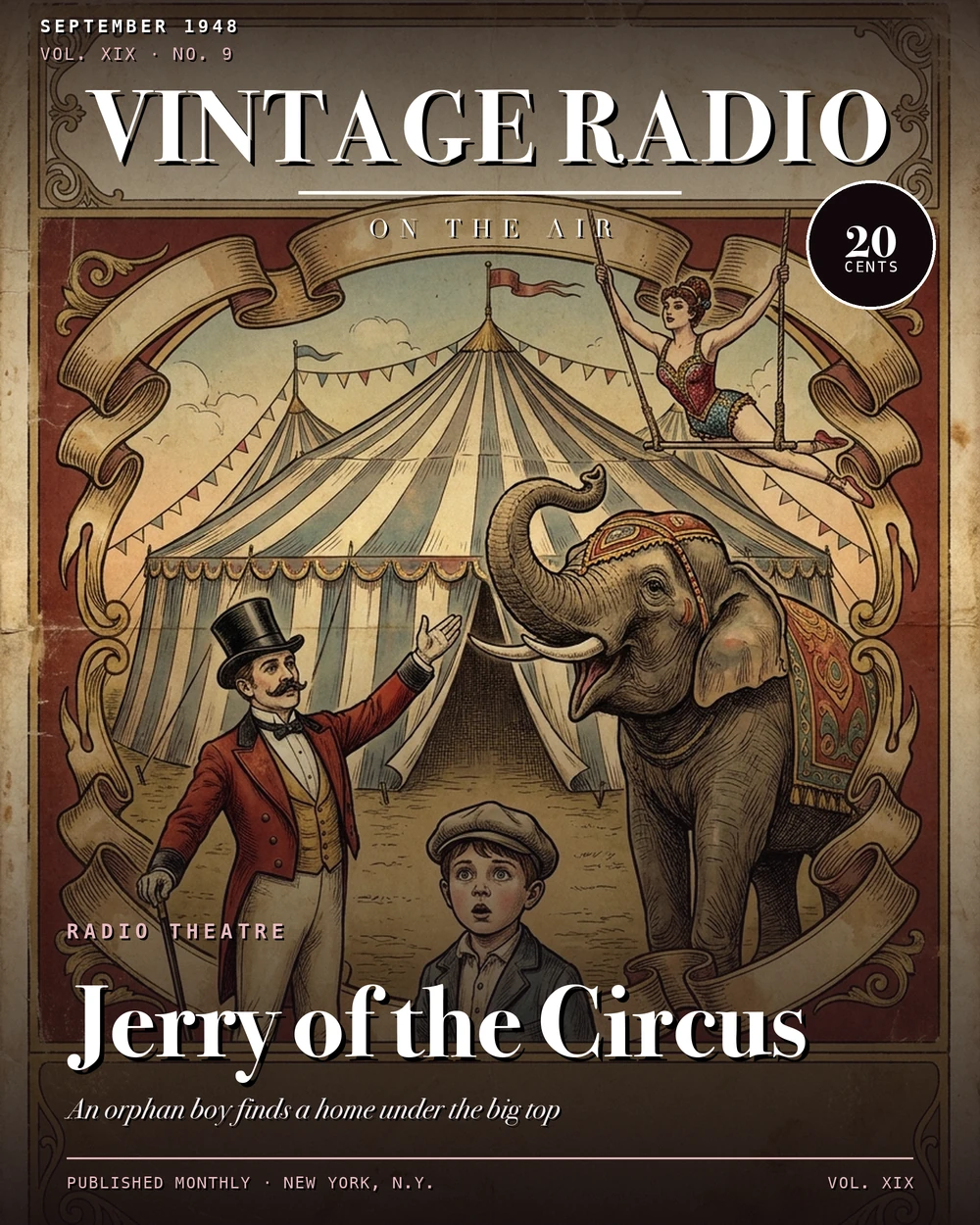
Jerry of the Circus
How Jerry Got to the Circus
Jerry Dugan didn't join the Randall Brothers Circus because he was starstruck. He got there because his father had just died and he had nowhere else to go. Presenting a note from his father saying he "has circus in his blood," the orphaned boy talked his way into the troupe and into the care of Sam Randall, the circus's owner. That backstory — poverty and loss driving a child into an unconventional world — gave the serial a grounding that set it apart from lighter fare. This wasn't a fantasy of running away to the circus. It was a story about a kid making the best of a hard situation.
Bruce Eells syndicated the show in 1937, with each episode running fifteen minutes. The first installment, "Letter For Sam Randall," aired June 28, 1937, and the run wrapped December 24, 1937 — tracking the full performance season of a traveling circus, from spring through the end of the circus year. That structure gave the show a natural arc across 130 episodes total, of which 128 survive. The pacing suited the daily serial format well: short episodes, a large recurring cast, and interlocking storylines that kept young listeners coming back.
The Cast and Characters
The named cast gives the show more texture than most children's serials of the period. Lindsay McHarrie played Sam Randall, the circus owner who becomes Jerry's guardian. Howard McNear — later famous as Floyd the Barber on The Andy Griffith Show — played Bumps the clown, the character who recruits Jerry's dog Rags for his circus act. Elvia Allman played Patsy, a trapeze artist. Gale Gordon, another actor who would go on to a long television career, appeared in an additional role alongside Buddy Duncan.
Rags, Jerry's dog, functions as a co-protagonist rather than a background pet. He's present throughout the entire run, and the episode titles — "Rags Is Missing," "Rags In Training" — make clear that storylines were built around him directly. The circus also populated Jerry's world with characters you don't often find in children's radio: Major Mike, a little person who considers himself the star attraction of the midway; Johnny Bradley, a Shakespearean clown; and Carmen Bandini, a tightrope walker with Hollywood ambitions. Carmen was voiced by the same actor who played the Girl Submarine Commander in the related children's serial Magic Island.
The identity of the child actor who played Jerry himself has never been publicly established.
The Mystery at the Center of the Story
The serial's backbone is a genuine mystery, and it's a good one. Decker — the circus's animal trainer — is actually Dan Dougan, Jerry's long-lost uncle. He doesn't know it. Amnesia has stripped away his past, and a knife-throwing performer named Lorenz has been exploiting that vulnerability, keeping Decker under his thumb through bribery. The episode titles "Lorenz Is Suspected" and "Lorenz And Decker Leave" chart how that situation builds and eventually breaks.
Other plot threads layer in beside the Decker arc. A stolen circus payroll ("Circus Payroll Stolen") introduces crime-serial elements. "Jerry In Jail" suggests the protagonist himself ends up in real trouble at some point. These aren't gentle lessons-about-sharing stories — they're adventure serials with genuine stakes, written for kids who could follow a multi-episode plot. The episode "Both In The Hospital" and the longer Jason storyline ("Jason Pays The Money," "The Gun Is Jasons") suggest a web of characters whose troubles intersect across the season.
That serial architecture — mystery identities, recurring antagonists, storylines that carry across weeks — was exactly what kept listeners tuned in episode to episode. The circus setting provided a self-contained world with enough variety that new characters and challenges could appear naturally without straining credibility.
How It Ended
The series resolved its central mystery by the final episode. Sam Randall formally assumes guardianship of Jerry once uncle Decker reclaims his identity and his former life as a big-game hunter. Jerry's story with the Randall Brothers Circus closes on December 24, 1937 — the final episode is titled "Jerry Leaves the Circus."
That ending was also a beginning. Sam Randall's decision to send Jerry to a military academy leads directly into a follow-up serial, Jerry at Fair Oaks, which ran for 65 episodes in 1937 as a continuation of the same story. The two serials together constitute a single extended narrative about Jerry Dugan growing up and finding his footing in the world — unusual continuity for children's radio of the period.
A Certified Accurate release of the complete series was issued on January 19, 2011, confirming the episode count and establishing the surviving 128 episodes as a reliable set. The run is nearly complete, which puts Jerry of the Circus in better shape than many serials from the same era.
What the Show Did Well
Fifteen-minute episodes sound short, but they're actually a tight fit for serial storytelling — long enough to move a plot forward, short enough that each installment has to count. Jerry of the Circus used that format efficiently, building multi-episode arcs around a stable cast of circus regulars while rotating in new complications. The sound design leaned on circus atmosphere — crowd noise, animal sounds, the general texture of a working show — to make the setting feel lived-in rather than abstract.
The recurring cast is unusually rich for a children's serial. McNear, Gordon, and Allman were working radio professionals, and the material they were given had enough complexity to reward that level of performance. Lorenz as a villain operates through manipulation and control rather than outright menace, which is a more sophisticated construction than the genre typically demanded. And Rags — practical, present, useful to the plot — is a better animal sidekick than most, because the writers actually wrote him into storylines rather than treating him as atmosphere.
The 128 surviving episodes represent a complete enough record to follow the full arc from Jerry's arrival at the Randall Brothers Circus to the moment he leaves it for military school. That continuity, across a single calendar year, makes Jerry of the Circus one of the more coherent children's serials to survive from 1937.